
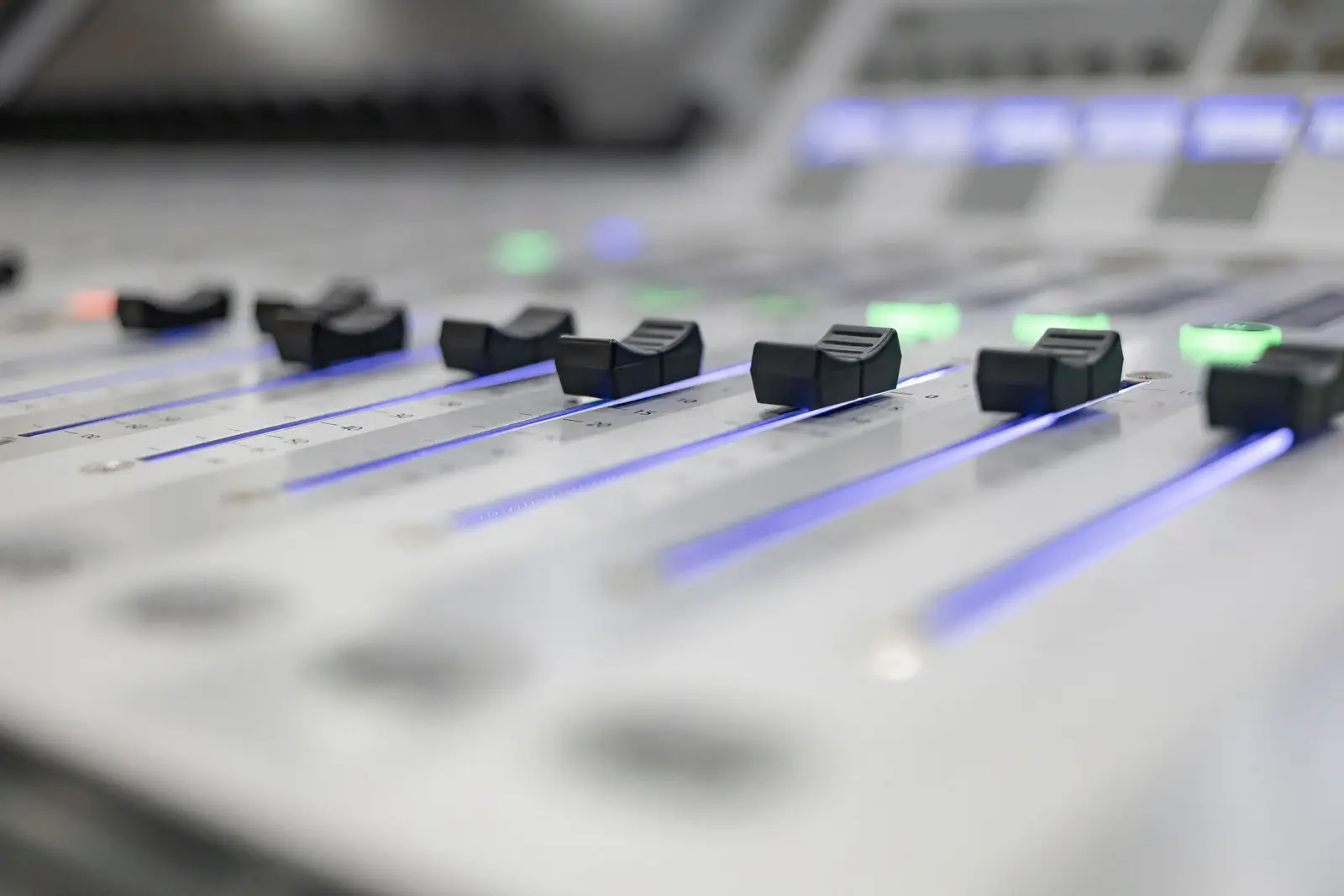



Studio credit
Elephant Audio
Audio production · Sound design · Music production
LahorePKEngineering sound since 2018
A US broadcast commercial delivers at -24 LKFS integrated under ATSC A/85 and the CALM Act, with a tolerance of plus or minus 2 LU and true peak no higher than -2 dBTP. European broadcast follows EBU R128 at -23 LUFS. Streaming platforms normalise playback to roughly -14 LUFS. A master cut for one target is not correct for another.
Targets published by each platform. Elephant Audio delivers to these specifications; the marks below identify whose specification each figure is.
This is the single most common source of confusion, and it costs people real money in rejected deliveries. LKFS and LUFS are not two different scales. Both are the loudness unit defined by ITU-R BS.1770 — a K-weighted, gated average of the whole programme. ATSC, the North American broadcast standard, calls the unit LKFS. The EBU, in Europe, calls the same unit LUFS. One LU equals one dB.
So the difference between the American target of -24 and the European target of -23 is not a difference of standards or units. It is one decibel. That is small enough that people assume it does not matter and large enough that a compliance system will reject the file.
“that the Programme Loudness Level shall be normalised to a Target Level of −23.0 LUFS. Where attaining the Target Level is not achievable practically (for example, live programmes), a tolerance of ±1.0 LU is permitted.”
Integrated loudness over the whole spot, with the true-peak ceiling each specification sets:
A delivery specification is a contractual requirement: hand in a file measuring this, or it is rejected. Playback normalisation is something the platform does after the fact — it measures whatever you uploaded and turns it up or down toward its own house target so the listener is not reaching for the volume between tracks.
The practical consequence is that mastering a streaming release louder than -14 LUFS buys nothing. The platform simply turns it back down, and everything sacrificed to get there — the dynamic range, the transients on the drums — is gone permanently while the loudness advantage is not. Nobody hears the extra level. They only hear the damage.
It also means the two kinds of number cannot be compared directly. Netflix asking for -27 LKFS dialogue-gated and Spotify normalising to -14 LUFS are not a contradiction, and neither is louder or quieter than the other in any meaningful sense. They are measuring different things for different purposes.
Integrated loudness is an average across the whole duration. That has a consequence people discover the hard way: a 15-second lift taken from a compliant 30-second master frequently does not measure the same, because the loud and quiet passages no longer sit in the same proportion. Cut the quiet opening off a spot and the average of what remains rises.
So every deliverable gets measured on its own — the 30, the 15, the 6, the vertical social cut, the radio edit. Measuring the master and assuming the children inherit it is the most common route to a spot being bounced back the day before air.
The same applies to a spot that is re-versioned for a different territory. A file that was correct at -23 LUFS for a European broadcaster is 1 LU hot for a US broadcaster, which is inside the plus-or-minus-2 tolerance and therefore usually passes — but stacked with any other drift it is what pushes a marginal file over.
The order matters: measuring before the mix is finished tells you nothing, and limiting after measuring invalidates the measurement.
Territory and platform, written down before the mix starts. US broadcast, European broadcast, streaming and theatrical are four different numbers, and the mix decisions that follow are not the same.
A mix built at the right level does not need to be squashed into compliance afterwards. Loudness compliance achieved with a brick-wall limiter on the master bus is audible, and on dialogue it is audible immediately.
Whole-programme, gated, per ITU-R BS.1770. Not a moment-to-moment reading, not the loudest section.
True peak is not sample peak. Inter-sample peaks appear after conversion, which is why a file reading -0.1 dBFS on a sample meter can clip a consumer D/A converter. Broadcast wants -2 dBTP in the US and -1 dBTP under R128.
Each duration, each aspect ratio, each territory variant. The integrated figure is duration-dependent, so inheritance does not apply.
The European and streaming targets on this page were read from the issuing documents, not from a summary. Both are linked so you can check them:
Not all of the figures above have the same standing, and no other reference we could find says so. Two are published specifications that anyone can open and check: EBU R 128 states -23 LUFS and a -1 dBTP ceiling, and Spotify states -14 LUFS along with its -11 and -19 listener settings. ATSC publishes A/85 as the governing US standard — currently revision A/85:2026-07, approved 8 July 2026 — and -24 LKFS with a -2 dBTP ceiling is the settled reading of it across the industry.
The streaming and delivery figures for Apple Music, YouTube and Netflix are different. Apple Music and YouTube still publish no numeric loudness target: Apple's Digital Masters page states no LUFS figure and no YouTube help page states one, so the commonly quoted -16 LUFS and -14 LUFS are industry convention, reported consistently but not something you can cite to the platform. Netflix is the exception. Its sound-mix specification now sits on a public studio-partner help centre and, read on 17 October 2026, sets -27 LKFS ±2 LU, dialogue-gated, for home mixes — a delivery target, not playback normalisation.
The practical consequence is narrow but real: if a delivery is rejected on loudness, you can point a broadcaster at EBU R 128 or ATSC A/85 and settle it. For a streaming platform there is no public document to point at, so the argument is empirical — measure the file, measure what the platform served back, and compare.
Tell us the territory and the platform, and every deliverable comes back measured to that target individually — the 30, the cut-downs, the social versions.
Projects the studio lists under Mixing & Mastering, the service line this guide sits under.
Yes. Both are the loudness unit defined in ITU-R BS.1770. ATSC calls it LKFS in North America; the EBU calls it LUFS in Europe. One LU equals one dB. The American broadcast target of -24 LKFS and the European target of -23 LUFS differ by exactly one decibel, not by unit.
The Commercial Advertisement Loudness Mitigation Act directs the FCC to require that commercials are not louder than the programming they accompany. The rules took effect on 13 December 2012 and are implemented through ATSC A/85, which sets the -24 LKFS target with a plus-or-minus 2 LU tolerance. It applies to advertising carried on US broadcast, cable and satellite television.
You can, but the platform will normalise it back down and nothing is gained. What is lost — dynamic range and transient detail sacrificed to reach that level — does not come back when the volume is reduced. The listener hears a quieter, flatter master rather than a louder one.
Integrated loudness averages across the whole duration, so a shorter cut taken from a compliant master often measures differently — usually louder, because the quiet passages that pulled the average down are no longer in it. Every deliverable has to be measured on its own file.
Sample peak is the highest value in the digital file. True peak estimates the highest level the waveform actually reaches between samples once it is reconstructed by a converter. A file that never exceeds -0.1 dBFS on a sample meter can still clip on playback, which is why broadcast specifications set a true-peak ceiling — -2 dBTP in the US, -1 dBTP under EBU R128.
Yes. Loudness specifications are numbers in a file, not a location — a spot mastered to -24 LKFS with -2 dBTP headroom is compliant regardless of which studio measured it. Tell us the territory and the platform in the brief and the master is made to that target, with each cut-down measured independently.
 What to ask for from an audio post house
This guide explains why the targets differ. If you only need the figure and the document it comes from:
Tell us the territory and the platform, and every deliverable comes back measured to that target individually — the 30, the cut-downs, the social versions.
Studio credit
Elephant Audio
Audio production · Sound design · Music production
LahorePKEngineering sound since 2018
Last updated: